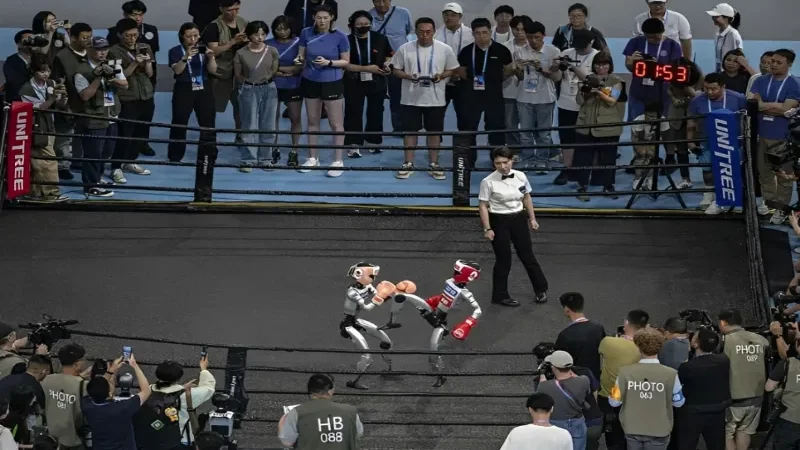
BEIJING: China’s rapidly evolving robot competitions are turning science fiction fantasies into real-world technology, as humanoid machines compete in sports and precision tasks at the World Humanoid Robot Games in Beijing, showing how quickly robotics has moved from university laboratories to everyday applications.
Once viewed mainly as academic experiments and hobby projects, China’s robot contests have developed into a major technology showcase. Over decades, the competitions have reflected the country’s growing ambition to become a global leader in robotics and advanced manufacturing.
The journey began with relatively simple machines. From 1999 through 2014, college teams competed in events featuring small-wheeled robots, including robot soccer. The machines depended largely on preprogrammed instructions and basic sensors, making the contests look more like science fairs than commercial technology demonstrations.
That changed in 2015, when Beijing hosted the first World Robot Conference. Robotics was increasingly presented as a strategic industry, a "crown jewel," following President Xi Jinping’s description of the sector as a key part of advanced manufacturing.
By 2023, the technology had moved closer to consumers. Companies were using major robot exhibitions to demonstrate machines designed for practical uses. Xiaomi’s Cyberdog, for example, attracted crowds while highlighting China’s growing advantage in producing relatively affordable robotic hardware.
The biggest leap came in 2025 and 2026, when humanoid robots entered races designed to test their ability to operate in environments built for humans.
At the first Beijing humanoid robot half-marathon in 2025, many machines struggled to stay upright. Some collapsed almost immediately, while others crashed into barriers. Just one year later, the results looked dramatically different.
In the 2026 race, a Unitree H1 humanoid robot completed the finishing stretch without a human chaperone. More than 100 teams entered, while 47 reportedly finished. One of the most striking performances came from “Flash,” a humanoid robot developed by Chinese smartphone maker Honor. It completed the half-marathon autonomously in 50 minutes, 26 seconds—nearly seven minutes faster than the human world record cited in the report.
The latest competitions are moving beyond speed. The 2026 World Humanoid Robot Games include challenges involving robotic hands, such as tightening screws, opening bottles and picking up beads with tweezers.
Dozens of humanoid robots and their human operators gathered at Beijing’s Olympic speed skating arena on Sunday, Aug 23, to compete in events including athletics, boxing, soccer and martial arts.
During the opening ceremony Saturday, a Chinese robot reportedly broke Jamaican sprint legend Usain Bolt’s 100-meter record, drawing major attention in Chinese state media.
That shift matters because the real test for humanoid robots is no longer whether they can entertain a crowd. It is whether they can perform useful work with the speed, accuracy and dexterity of humans.
For decades, movie robots existed only in imagination. China’s robot Olympics suggest that some of those futuristic ideas are now stepping into the real world one race, one robotic hand and one breakthrough at a time.