Context:
Under the ruling Bharatiya Janata Party (BJP), India’s Armed Forces are increasingly showing signs of saffronization, with critics alleging that the military is acting as a “yes man” for Prime Minister Narendra Modi.
Reports indicate that elements within the armed forces have been involved in publicly passing political statements, participating in Hindu rituals, and adopting religious symbolism, reflecting a growing alignment with political elites.
Observers warn that these developments blur the line between military impartiality and political-religious agendas, raising concerns over the long-standing secular and inclusive ethos of India’s military.
Numerous incidents suggest a deliberate move toward Hindu nationalist symbolism, politicization, and the marginalization of religious minorities, challenging the foundational principles of neutrality and pluralism within the Armed Forces.
Important Aspects
- Religious Symbolism in Military Spaces:
▪︎ In December 2024, the Fire and Fury Corps unveiled a statue of the 17th-century Hindu king Shivaji near Pangong Tso in Ladakh, flanked by a saffron flag—an act asserting Hindu identity in a strategically sensitive region.
- Religious Rituals and Political Statements by Military Leaders:
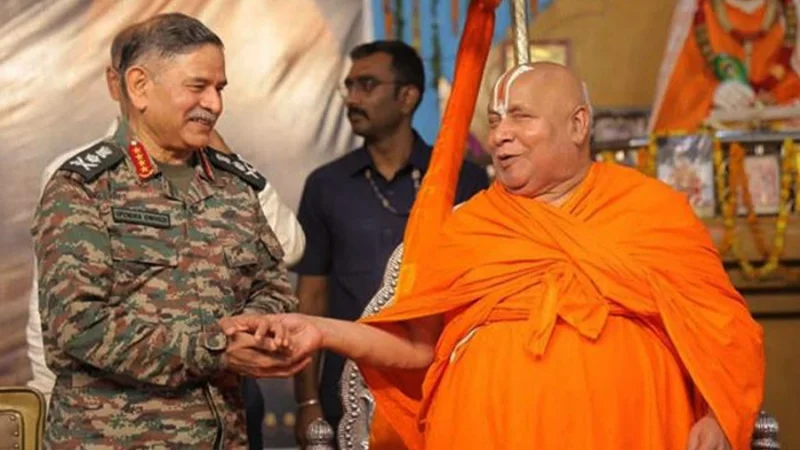
▪︎ Paid religious visits, such as the COAS’s visit in May 2025 to Hindu spiritual leader Rambhadracharya’s ashram in Madhya Pradesh; where he received religious initiation, highlight the blurring of institutional boundaries between military duty and religion.
- Politicization of Military Operations:
▪︎ Senior military officials have made statements echoing BJP’s hardline rhetoric, including threats to Pakistan, openly aligning military discourse with nationalist politics.
- Institutional Changes and Recruitment Influence:
▪︎ Sainik Schools, vital in shaping future officers, are increasingly influenced by Hindu nationalist groups like Vidya Bharati and Ram Mandir movement affiliates, embedding saffron ideology into the military’s leadership pipeline.
- Symbolic & Cultural Shifts:
▪︎ On May 25, following the Indo-Pak ceasefire, the COAS visited the ashram of Hindu spiritual leader Jagadguru Rambhadracharya in Chitrakoot, Madhya Pradesh, while in uniform, drawing sharp criticism from SMNs for crossing the secular and apolitical boundaries expected of armed forces.
▪︎ The religious leader claimed to have given the COAS diksha (initiation, analogous to Lord Hanuman’s in Hindu tradition). In return, he asked the COAS to reclaim AJK as a dakshina (offering/gift), effectively positioning the COAS not as a purely institutional officer but as a student of a religious figure, bound by a religious obligation.
- Impact on Minority Officers & Complaints:
Complaint records include the case of Lt. Samuel Kamalesan, a Christian officer dismissed in 2025 for refusing to participate in Hindu rituals his dismissal being upheld by the Delhi High Court.
▪︎ Minority officers face professional insecurity, social exclusion, and career stagnation, with some resigning or considering resignation due to coercive practices, although no large-scale mass resignations are publicly confirmed.
- Other Evidence & Reports:
Conclusion.
The systematic saffronization of India’s military, driven by ideological, political, and religious factors, manifests in symbolic changes, politicized leadership, religious rituals, naming conventions, recruitment influences, and discrimination against minorities. Indian armed forces turned into Modi Ki Sena.
This transformation endangers the military’s secular, neutral character, jeopardizing its cohesion, professionalism, and social legitimacy, while promoting majoritarian Hindu nationalist narratives within one of the country’s most critical institutions.