




And the brain drain continues…
-
18th Dec, 2022. 09:02 am


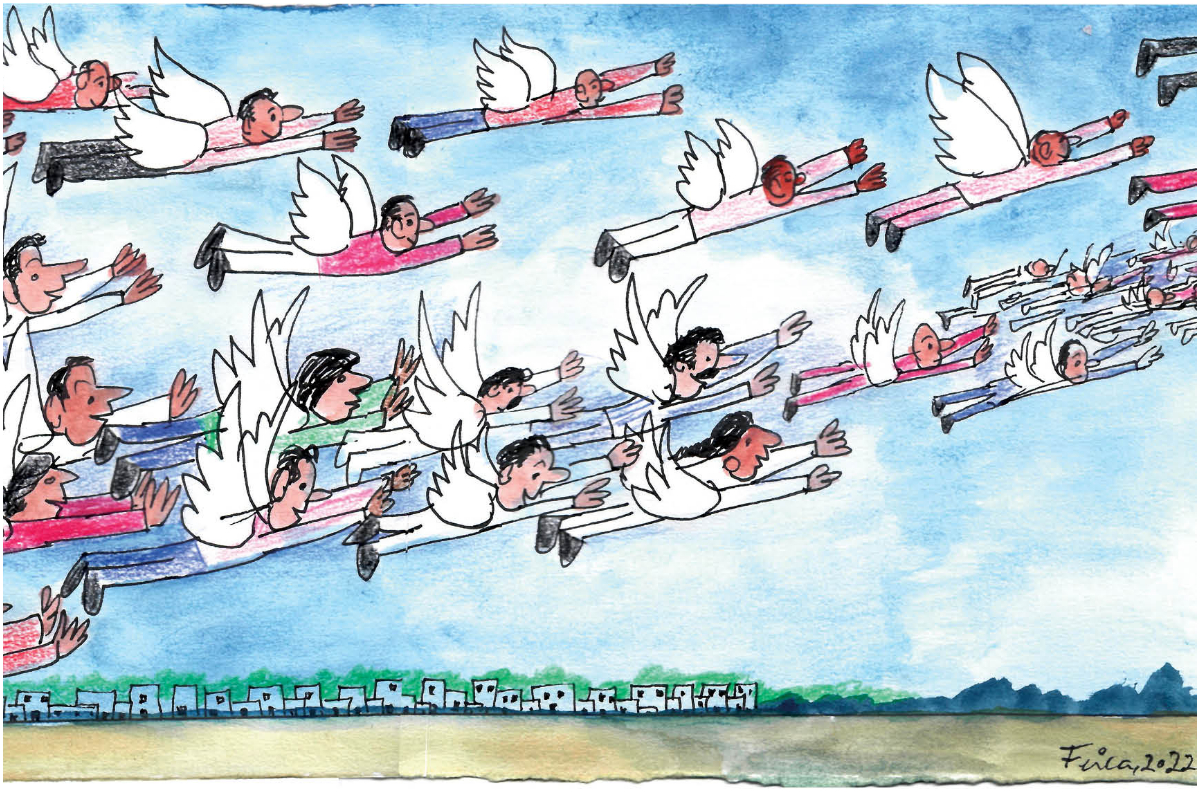
And the brain drain continues…
A three-time jump in Pakistanis leaving abroad for jobs
Karachi: Faced with crisis upon crisis, this year forced 765,000 people to leave Pakistan for greener pastures, which is nearly four times higher than in 2020 and almost thrice as much as last year.
According to the document of the Bureau of Immigration,
the so-called brain drain figure stood at 225,000 in 2021 and 288,000 in 2020.
In the last 12 years, the steepest rise in Pakistanis moving abroad was seen in 2015 when over 900,000 people left the country to avail of overseas employment opportunities. The year 2020 and 2021 were largely mired by the Covid-19 pandemic, coupled with the global recession and travel restrictions.
According to the UN Department of Economic and Social Affairs, Pakistan has the 6th largest diaspora in the world. The reason: its skilled manpower is cost-wise, cheaper, considerably efficient and reliable, and can easily adapt to different cultures and conditions across the globe.


There are about nine million Pakistanis living and working the world over, which constitute about four per cent of the country’s population. In a recent survey conducted by the Pakistan Institute of Development Economics, 33 per cent of Pakistanis were ready to leave the country if they get a chance. The severe economic hardship, which may have forced extraordinary migration this year, included 92,000 highly-educated and professionally sound individuals such as doctors, engineers, information technology experts and accountants.
The loss of highly qualified human capital has pushed the country’s growing economic crisis into a dark abyss. This year’s migration also includes 350,000 highly trained workers and the same number of untrained labourers, resulting in a reduction in local investment and productivity because of the low availability of skilled workers.
As per details revealed by the Ministry of Overseas Pakistanis and Human Resource Development, approximately 8.8 million Pakistanis live abroad, with the vast majority, over 4.7 million, residing in the Middle East. The second-largest community, at around 1.2 million, live in the United Kingdom; followed in third place by the United States (especially New York City, Chicago, and New Jersey).
Experts believe that above a certain level, brain drain reduces the stock of human capital and induces unimaginable losses. Human capital determines the rate of development and progress. For instance, Pakistan requires more than 0.4 million doctors, 0.2 million dentists and 1.6 million nurses to meet international standards. Thus the massive migration has created a shortage of more than 0.2 million doctors, 0.18 million dentists and 1.4 million nurses, adversely affecting our healthcare system.


Experts believe that a shortage of manpower undermines a country’s ability to adopt new technologies or deal with health crises. The Bureau of Immigration document reveals that emigrating educated youth included over 5,000 engineers, 18,000 associate electrical engineers, 2,500 doctors, 2,000 computer experts, 6,500 accountants, 2,600 agricultural experts, over 900 teachers, 12,000 computer operators, 1,600 nurses and 21,000 technicians. The group of unskilled workers comprised 213,000 drivers.
According to the document, over 730,000 youth went to the Gulf States, and nearly 40,000 went to European and other Asian countries. The country-wise breakdown of the data showed 470,000 Pakistanis headed to Saudi Arabia for employment, 119,000 to UAE, 77,000 to Oman, 51,000 to Qatar 2,000 to Kuwait, 2,000 Pakistanis went to Iraq, 5,000 to Malaysia, 600 to China, 800 to Japan, 136 to Turkey and 500 to Sudan in Africa in search of employment.
The preferred choice was either Saudi Arabia or the UAE. Romania remained the top choice for Pakistani immigrants to Europe with over 3000 people, followed by 2,500 to the UK, 700 to Spain, 600 to Germany,500 to Greece, 300 to Italy and 700 people to the United States.
More than half of those leaving the country were from Punjab, followed by Khyber-Pakhtunkhwa and newly-merged tribal districts and then Sindh, Azad Kashmir and Balochistan.
But there is also a flip side to this and like other developing countries it is not necessarily bad news for Pakistan which is one of the world’s biggest beneficiaries of migrant remittances. Remittances from overseas Pakistanis have grown nearly threefold in 10 years, from $11.2 billion in FY11 to $29.4 billion in FY21. The key remains in maintaining the right balance for the benefit of the country.
Catch all the Business News, Breaking News Event and Latest News Updates on The BOL News
Download The BOL News App to get the Daily News Update & Live News.