






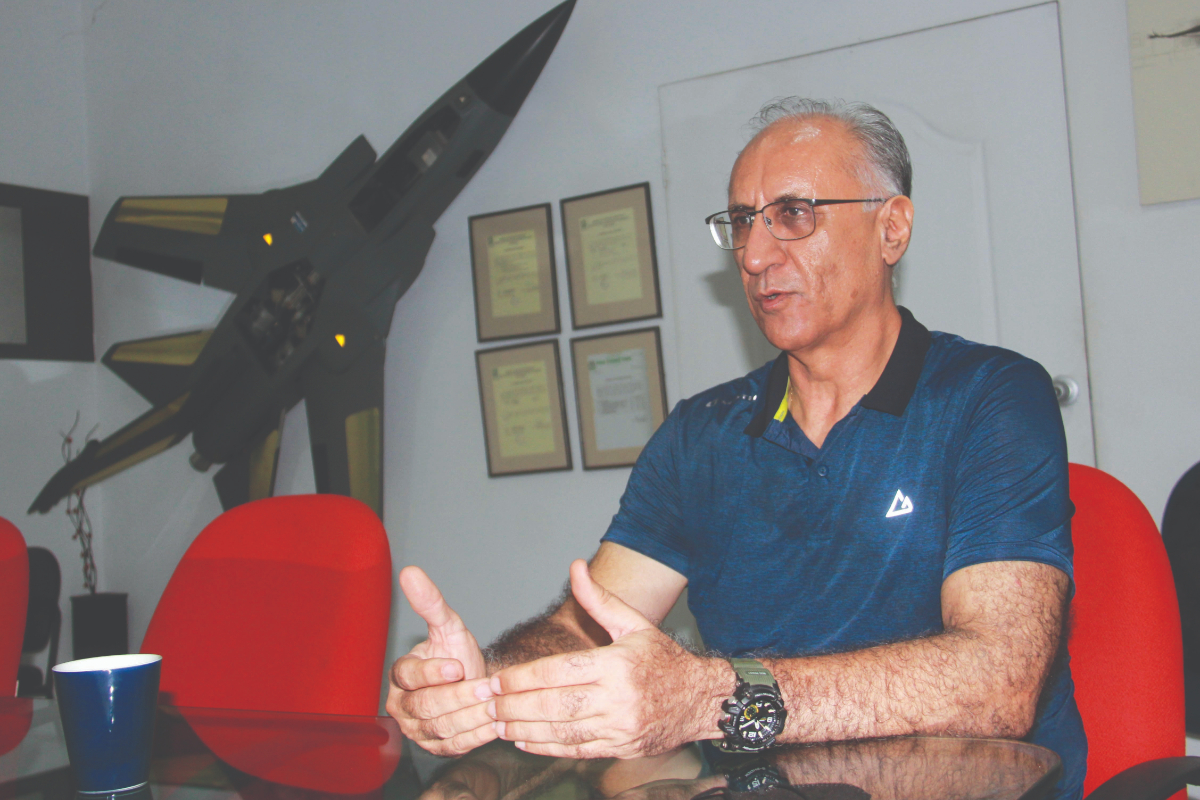
In conversation with Raja Sabri Khan
Regulatory framework for drones needed in Pakistan
Raja Sabri Khan is the CEO of Integrated Dynamics which provides design, consultancy and turn-key project commissioning for Unmanned Autonomous Vehicle Systems (UAVS), in short, drones.
Their new ‘Civilian’ UAV systems portfolio, includes systems that are designed for emerging applications in the areas of law enforcement, border and coastal patrol, and scientific research. Most systems require no more than two crew members to operate. Bolnews sat down with him to find out about the making of drones in Pakistan.
Tell us something about your background?
I received my initial schooling in Lahore. After my family shifted to Karachi, I attended the Habib Public School and DJ Science College before joining the Mechanical Engineering program at NED University. My mother wanted me to take CSS exam and join the police; an aspiration that I am happy I ignored.
Advertisement
What made you choose an unconventional profession?
I was fascinated with flight and airplanes from an early age. One of my fondest memories is that of watching a small 12 inch wingspan glider, that I had constructed myself, disappear into the mountains at Nathiagali, after I had gently tossed it into the air. I think this particular event made me believe that I could make airplanes.. It spurred a lifelong passion for aircraft design and unmanned aircraft or drones.
Tell us about your career path?
My first job, after completing my degree in mechanical engineering, was at the Sui Gas Co., while completely unrelated to my career ambitions, it was the only job available to me at the princely salary of Rs 1100 per month in 1981. I put my head down, learnt a lot, and was probably going on to make a career in the gas pipeline industry, when someone suggested that I should try and study abroad for a Masters degree.
Since my heart was in aviation, and no universities were offering courses in aerospace locally, I applied to the Massachusetts Institute of Technology (M I T) for the Masters programme in Aeronautics & Astronautics. I was lucky to be accepted at MIT, mainly because of some research publications done during my NED university years that were interesting for the review committee. I completed my Master’s programme with a thesis in record time within 7 months, and came back to Pakistan to make a career for myself in aviation.
What are some of the challenges you faced in your career?
Advertisement
Every day in Pakistan is a challenge. When I came back from the US, I could not find a job in my chosen field and had to settle for a well-paid job making agricultural tractors. After making tractors for nearly 5 years, I was lucky to get selected as Director (Special Projects) in SUPARCO and spent 9 years there, developing Pakistan’s first unmanned aircraft for civilian remote sensing applications.
How did you get your first break in the field of drone designing?
My interest in drone design stemmed from my hobby of designing and building free flight and radio controlled model aircrafts. I always felt that my hobby was ground zero, in the quest for many frontiers linked to exploration in the areas of air and space applications. SUPARCO afforded me a unique opportunity to do R&D in my chosen field and offered me with the resources to experiment and create unmanned systems.
What prompted you to set up this company?
After working in SUPARCO for a number of years, I became convinced that we were not really addressing the needs of the country, in developing specific types of drones for civilian and military applications. Being a bureaucratic organisation, everything took time to materialize. Time that I did not want to waste. So I resigned and set up Integrated Dynamics (ID), with a mechanic, a carpenter and a painter, as my team, on the roof of my parents’ house in 1997 and made prototypes or demonstrations. That little workshop still exists.
Your current projects?
Advertisement
Since most of our work is focused on projects for the Armed Forces, sharing details is not permitted. Through our startup DRONESERV we are working on several civilian applications of drones including agriculture, search and rescue, deliveries, disaster management, land mapping and surveying.
Give us an example of specific memorable work you did?
One of the earliest projects, and my most memorable, was the work that ID conducted on the design, development and flight testing (from 2001-2009) on the conversion of a large, manned aircraft for unmanned operations.
It was a career defining period and a sense of great achievement, against the many challenges that we faced as a team and found solutions.
Any professional disappointment?
I think every profession has its share of successes and failures. I have had many ups and downs in my career, but the one singular fact that I always regret is that we end up ignoring what was achieved before and start ‘re-inventing the wheel’ every few years. These regressive policies and lack of official support in private sector R&D have caused untold damage to the innovative spirit of many of our brightest young minds.
Advertisement
Give us a brief history of drones?
Drones have been around as aircraft simulators, aerial targets, and test platforms for almost the same time as full size manned aircraft. Their design has evolved, like the manned aircraft they mimic, over time. The availability of low-cost, micro miniaturized, sensors and components and the dispersal of information through the Internet has led to levels of design and innovation in drones that would have been impossible a couple of decades ago.
What is the difference between the use of drones for defence and civilian use?
There is the same difference as between a civilian light airplane and a fighter jet. Drones for civilian applications are designed to be used in less hostile environments and are not ‘ruggedized’ like military drones to keep operating costs down. The performance spectrum of military drones is also set at different, and higher, levels as compared to civilian drones.
Tell us something about the development of drones in Pakistan?
ID was the first company in Pakistan to start the design and manufacture of drones for military surveillance applications. Since then a number of other companies have come up, aided by the demand for this technology around the world, and many of them are startups doing extremely innovative work. Government policies and regulations still do not allow for a free and fair atmosphere to conduct research in this area for the private sector and need to be addressed if we are to become a global force in this multi-billion dollar industry.
Advertisement
Any other details you want to share?
The Government needs to implement a regulatory framework for drones as soon as possible. They also need to allow tax-waived and duty free imports of drone components so that local companies can innovate and create freely. Flight test areas need to be designated where registered companies can test their drones and equipment. The longer these steps are delayed the longer the industry will continue to suffer.
Any idea of the cost of a drone?
Civilian drone cost starts from a few hundred dollars and can go up to $30,000-40,000 for a system. Military drone costs generally are much higher, running at around 10 times the pricing for civilian drones. The cost of a Predator armed drone is between $18-22 million.
photo: asim rehmani/Bol News
Advertisement
Catch all the Breaking News Event and Latest News Updates on The BOL News
Download The BOL News App to get the Daily News Update & Live News.
End of Article



Advertisement

 Read the complete story text.
 Listen to audio of the story.