






Targeting Judiciary
When it comes to confronting institutions, including superior judiciary, the Sharif family has a sordid history
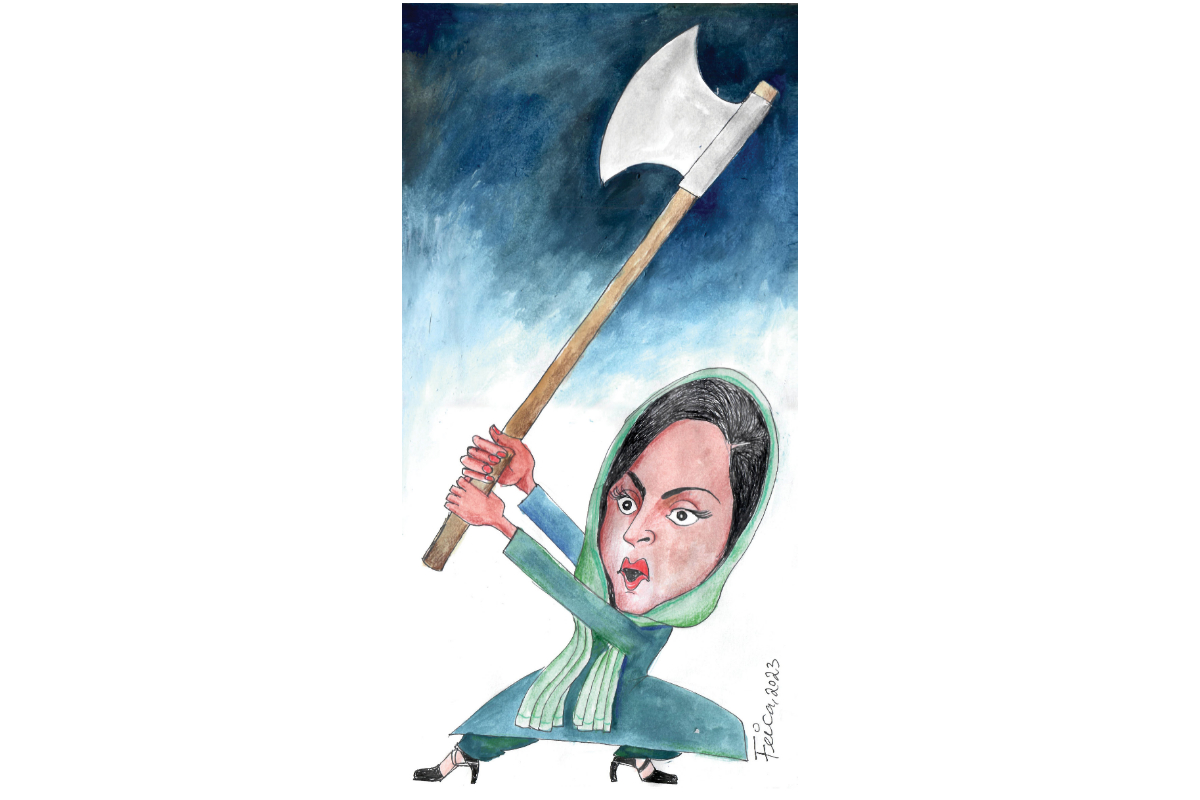
LAHORE: Maryam Nawaz, former premier Nawaz Sharif’s political heir, has launched a propaganda blitz against three serving judges of the Supreme Court of Pakistan, including the Chief Justice Umar Ata Bandial, which marks yet another dangerous turn in Pakistan’s highly polarized politics.
Maryam, who has recently been nominated by her father as the chief organiser of his Pakistan Muslim League-Nawaz (PML-N), while hurling allegations against the honourable superior court judges in a recent rally in Sargodha, accused them of being “biased” against her party’s leadership. Her outburst against the judges is not just seen as a blatant contempt of court by many of the country’s top lawyers, but a tried and tested method of exerting pressure on the honourable judges to prevent them from rendering any decision that could be detrimental to their political objectives.
Her targeting of the judges coincides with the hearing of the all-important case pertaining to the unconstitutional delay in the announcement of the date of elections in Punjab and Khyber-Pakhtunkhawa in 90 days following the dissolution of their assemblies. A nine-member bench of the Supreme Court, headed by the chief justice, is hearing the case. The bench has issued notices to all concerned for February 27.
Maryam, while displayed photographs of former chief justices Saqib Nisar and Asif Saeed Khosa, two sitting SC judges — Justice Ijazul Ahsan and Justice Mazahar Ali Akbar Naqvi, and former ISI chief Lt. Gen. Faiz Hameed – said that she remains prepared to face consequences for her actions. “The people should see these faces as they were behind the conspiracy against Nawaz Sharif’s ouster from power (in 2017),” she alleged. In her speech, Maryam had also criticized the current Chief Justice of Pakistan.
Advertisement
Maryam’s tirade against the judiciary reflects how the Shehbaz Sharif government is trying to take on the judiciary, which is seen by a vast majority of Pakistanis as the last line defending their constitutional and basic rights.
Although the Sharifs keep paying lip-service to the cause of justice, fair-play, rule of law, and supremacy of the judiciary, it is basically a smoke-screen behind which they try to hide their real intentions.
Historically, the PML-N remains infamous for targeting the judiciary and launching nefarious campaigns against independent judges, who act in line with the law and the constitution. The PML-N is also notorious for trying to win over the judges through bribes, intimidation and even blackmail.
Past haunts PML-N
In 1997, differences emerged between the judiciary and prime minister Nawaz Sharif when the then Chief Justice Sajjad Ali Shah recommended five judges from three High Courts for elevation to the vacant permanent seats of the SC. The PM himself was resisting the appointments of the recommended judges because two of them from the Lahore High Court were unacceptable to him.
The Federal government immediately issued a presidential notification, dated August 21, 1997, reducing the number of the Supreme Courts judges from 17 to 12. The notification was suspended on September 5, by a SC’s three-member bench headed by the Chief Justice, forcing the government to withdraw the notification on and on September 16. But the recommendations of the Chief Justice were yet to be implemented as the government resorted to delaying tactics.
Advertisement
Meanwhile, yhe PML-N government passed the 14th Constitutional Amendment, adding a new Article 63-A in the Constitution for the disqualification of the members of the Parliament on the ground of defection. This amendment was challenged in the Supreme Court and a three-judge bench of the Supreme Court headed by the Chief Justice suspended the constitutional (14th Amendment) Act 1997. The suspension was criticised in extremely intemperate language by Prime Minister Nawaz Sharif, his Cabinet members and members of the Parliament. In his press conference, the PM called the short order of the Supreme Court, suspending the said amendment, ‘illegal’ and ‘unconstitutional’. He accused the chief Justice of reviving horse trading in the country, leading to the contempt of court proceedings against the PM and some members of the Parliament. Nawaz Sharif, appeared before the five-member bench headed by the Chief Justice himself on November 17 and 18, 1997, and expressed his regrets in a written statement over his remarks. But the court wanted an unconditional apology which he did not tender.
Fearing conviction and end of his political career, the Parliament passed the Contempt of Court (Amendment) Bill on November 18 1997, making any order of punishment for contempt of court by a Bench of the Supreme Court appealable before another Bench, comprising the remaining judges of the top court. It was also provided that such a sentence would not be effective for 30 days, during which an appeal could be filed. A Supreme Court Bench headed by the Chief Justice on November 20, 1997, restrained the President from signing it.
Nawaz Sharif used another method, on November 26, a petition was presented before the SC Quetta Registry, challenging the appointment of Justice Sajjad Ali Shah as Chief Justice. A two-judge bench, comprising Justice Irshad Hassan Khan and Justice Khalil-ur-Rehman, passed an interim order restraining the Chief Justice from performing his functions till further order.
This interim order from the Supreme Court Bench in Quetta was not less than a severe earthquake in the Superior Judiciary, which jolted every segment of Pakistan. Basically, even the entertainment of a constitutional petition in Quetta Registry was against Order XXV of the Pakistan Supreme Court Rules 1980 which says: “All constitutional petitions and applications can be entertained and registered only in the main Registry at Islamabad”.
It is widely believed that the interim order of the Quetta Bench was obtained by manipulation. Two retired judges of the Supreme Court and the then Chief Minister of Punjab Shehbaz Sharif flew to Quetta on November 25, 1997 on a special plane. Advocate Sharifuddin Pirzada, who was privy to the whole plan, was also there.
Ardeshir Cowasjee – a prominent analyst of his time – writes in an article (Laughing at ourselves, published in Dawn) that Justice (Retd) Rafiq Ahmad Tarar was dispatched to Quetta by Nawaz Sharif in a special flight, which landed at night. The security man on duty was reported to have noted in his log: “Instructions have been received from Islamabad that the details of the special flight carrying the visiting dignitary, Senator Rafiq Ahmad Tarar, must be kept confidential and not reported.” The same man (Tarar) was accused by a former President of Pakistan (Farooq Ahmed Laghari) of “taking briefcase of money” to bribe other judges in this famous 1997 case. Tarar was rewarded for his services and made President of Pakistan by the PML-N government in 1999.
Advertisement
Chief Justice Sajjad sitting in Islamabad suspended the order of the Quetta Bench through an administrative order. Simultaneous to the events in Quetta, a similar petition was presented before the Supreme Court Bench of two judges at Peshawar. The Bench at Peshawar entertained the petition on November 27, 1997 and passed an interim order restraining Justice Sajjad from passing any judicial or administrative order in his capacity as the Chief Justice of Pakistan. The Bench consisting of Justice Saeeduzzman Siddiqui and Justice Fazal Illahi Khan had issued the order. Justice Siddiqui was also rewarded and dished out governorship of Sindh.
On November 27 1997, a five-member Bench in Islamabad headed by the Chief Justice Sajjad himself, suspended by majority four to one, the Quetta decision of the three judges passed on the evening of November 26 1997. Some of the PM’s party lawyers, who were also members of the Parliament, disrupted the court proceedings.
Friday, November, 28 1997, is still remembered as the blackest day in the judicial history of Pakistan. On this date, the Supreme Court Bench headed by the Chief Justice Sajjad Ali Shah took up the contempt case against the Prime Minister. Under a pre-planned move, the PML -N workers, including Saif-ur-Rehman, head of the Accountability Bureau, and a well-known PTV programme host turned politician MNA Tariq Aziz, stormed the Supreme Court building, thus preventing the Bench from continuing its hearing. It was one of the most deplorable assaults on the courts in the country’s judicial history, obviously sponsored by the government and led by its ministers and members of Parliament and provincial Assemblies.
Meanwhile, President Farooq Laghari resigned on December 2, 1997 in protest against what he termed in his press conference the ‘unconstitutional demands’ of the government to de-notify the appointment of the Chief Justice Sajjad Ali Shah and appoint Justice Ajmal Mian in his place. Wasim Sajjad (the then Senate Chairman) assumed the office of acting President after the resignation of President Laghari and approved the summary of appointment of acting Chief Justice of Pakistan. Justice Ajmal Mian took the oath of acting Chief Justice of Pakistan on Dec. 2, 1997.
Soon after, the 10-member Bench of the Supreme Court, headed by Justice Siddiqui, commenced the hearings and announced the judgment on December 23, 1997, ruling that the appointment of Justice Sajjad as Chief Justice, superseding three judges of the court, who were senior to him, was made without any concrete or valid reason. Such an appointment was, therefore, unconstitutional, and illegal. The Court ruled that Justice Sajjad would cease to hold office as the Chief Justice of Pakistan.
On December 23, 1997, the federal government de-notified Justice Sajjad as Chief Justice and notified Justice Ajmal Mian in his place.
Advertisement
In 1999, Justice Malik Qayyum, brother of PML-N MNA Pervaiz Malik, delivered a guilty verdict against Benazir Bhutto and her husband in the SGS/Cotecna reference case. Later, a British newspaper revealed recorded conversations between the judge and the former Law Minister, Khalid Anwer, the former chief of the Accountability Bureau, Saifur Rehman and the former Chief Justice of Lahore High Court, Justice Rashid Aziz. It came to fore that Justice Qayyum had announced a pre-written judgment in the case. The newspaper story claimed that the bugging allegedly disclosed that the former prime minister, Nawaz Sharif, was intent on securing Benazir Bhutto’s conviction at any cost. He has also threatened Qayyum of removal. The tape transcript reproduced by the newspaper showed that Justice Qayyum even asked Saifur Rehman for advice on the sentence. “Now you tell me how much punishment you want me to give her?”
Qayyum assured the then CM Punjab Shehbaz Sharif that it is all right. It will be done as per Mian Sahib’s (PM Nawaz) desire. The order with regards to freezing of properties and assets of Zardari and Benazir was passed on April 27, 1998, while on April 30, 1998, prime minister Nawaz Sharif approved the grant of diplomatic passports to Judge Qayyum and his wife, ignoring the formidable objection raised by the Ministry of Foreign Affairs that judges could not be issued diplomatic passports.
Qayyum was judged as biased by a seven-member Supreme Court bench while deciding the appeal of Benazir and Zardari. The apex court judgement had said that the political bias of Qayyum reflected in the judgement. Another judge, justice Rashid Aziz Khan, who co-authored the judgement along with Qayyum against Benazir during deposed Prime Minister Nawaz Sharif’s tenure, had also resigned as Supreme Court judge.
Benazir had argued that the conviction was engineered by the Sharif government and alleged a nexus between the then law minister and Qayyum.
In 2020, an accountability judge Arshad Malik claimed that he was offered a Rs500 million cash bribe by the son of former prime minister Nawaz Sharif, Hussain Nawaz, who demanded that the judge resign on grounds that he “could no longer deal with the guilt of having convicted” Nawaz under duress in the Al-Azizia/Hill Metal Establishment reference. He had convicted ex-premier Nawaz Sharif in the Al-Azizia Steel Mill reference in 2018. However, the judge had also acquitted the former prime minister in the Flagship Investments reference.
Later, the seven-member administrative committee of the Lahore High Court headed by the Chief justice dismissed from service for misconduct on the basis of an investigation into a video released by PML-N leader Maryam Nawaz, showing the judge ‘confessing’ to convicting Nawaz under duress. The inquiry report declared Malik guilty. The judge had confessed to being in a compromising situation but claimed that he was trapped after being sedated. After that PML-N Vice President Maryam Nawaz released the video clip of the judge. Yes, some things never change in the Sharif family’s practice book.
Advertisement
Catch all the National Nerve News, Breaking News Event and Latest News Updates on The BOL News
Download The BOL News App to get the Daily News Update & Live News.
End of Article



Advertisement

 Read the complete story text.
 Listen to audio of the story.