







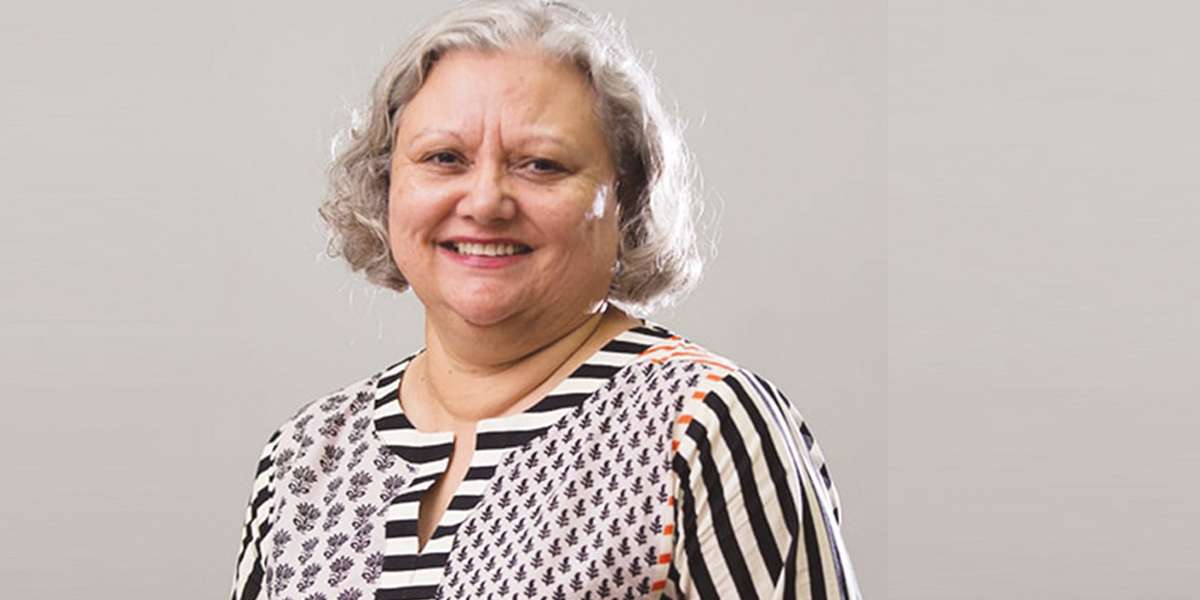
Niilofur Farrukh, a Karachi-based art critic, author, and columnist, lectured on the topic “Public Art: Harnessing Transformative Energy” on May 12th at Aga Khan University’s 6SF speaker series. 6SF is a forum at the Aga Khan University that encourages intellectual interaction and conversation by inviting speakers to speak about current social, cultural, and economic concerns.
Farrukh’s lecture gave a visual history of Public Art in Pakistan, tracing how it began as government commissioned monuments and has evolved into a variety of artistic interventions. She cited examples of art’s transformative impact and the role it plays in fostering social cohesiveness and providing social activists, students, and disadvantaged groups a voice.
The discussion centred on the phenomena of Public Art as seen through the lenses of interaction, discourse, and intervention. This discussion highlighted how presenting art in public areas is a strong method of influencing creative practice and affecting the audience, coinciding with the opening of cities throughout the world and the relaxation of COVID-19 limitations.
“As you all know, Karachi is a colonial city actually, all our monuments originate from that period, so here we have our tribute and our history tied to the colonial era,” Niilofur stated.
And while recalling her previous workshops and exhibitions at Pioneer Book House Karachi, she stated, “We put up exhibitions there, we had tiny book reading sessions over there, and then we gained visibility.”
Advertisement
She mentioned the International Public Art Festival (IPAF – 2019), which was held outside the KPT headquarters in Karachi. The incredible part of this show was that it took place within the containers, each of which had a collection of artworks that told a distinct story.
Then, while displaying glances of IPAF 2020, she mentioned that it was labeled as ‘Karachi Ki Khoj’ since a large number of artists asked, “What Karachi is?” and each of them had their own opinion.
“The public were able to see it and see the entire diversity which Karachi is today the communal diversity, the ethnic diversity and of course the linguistic diversity,”.
Murals, sculptures, memorials, landscape architecture work, community art, digital new media, and even concerts and festivals have all been examples of public art. It has interpreted the history of the location and its inhabitants, as well as addressed current social and environmental issues. Public art helps communities thrive by instilling a sense of identity, humanising the physical environment, and creating memorable experiences for everybody.
“Art has always made one look beyond the obvious. Innovative ideas expressed through art, provoke thought and interaction. Public Art has heralded an important shift from the exclusive to the communal and created dialogue and cross-disciplinary partnerships on common issues of concern.”
Farrukh presented the example of the Karachi Biennale, a city-wide event with the mandate of “Connecting Art, the city, and its People,” and elaborated on how the previous two Biennales in 2017 and 2019 used art to enlighten, connect, and vitalise public audiences. In KB17, artists from Pakistan and beyond responded to the theme ‘Witness’, whereas in KB19, they focused on the disastrous ‘development impact’ on the environment. Both Biennales drew massive crowd and participants from educational institutions.
Advertisement
The third iteration of Karachi Biennale will take place from October 29 to November 14, 2022, at seven public venues around the city, several of which are heritage monuments, and will examine the convergence of art and technology.
“We are exploring the area around Denso Hall, which is one of the old commercial/residential spaces, and the work that we are going to be displaying there is very related to the history of that area, “she explained to the audience.
Niilofur Farrukh, a Karachi-based art interventionist, has enlarged the space for art publishing, curation, and public art in Pakistan via his work. She is the author of three novels and writes a weekly piece for The Karachi Collective, an online forum. She was the Vice President of the International Art Critics Association (Paris) Board of Directors. Niilofur is now the CEO of the Karachi Biennale and the Managing Trustee of the Karachi Biennale Trust.
Advertisement
Catch all the Breaking News Event and Latest News Updates on The BOL News
Download The BOL News App to get the Daily News Update & Live News.
End of Article





Advertisement

 Read the complete story text.
 Listen to audio of the story.