






‘One-third Pakistanis willing to move abroad’
Rural society found happier than those living in cities
Karachi: Though every Pakistani claims to love his country, if the opportunity is available, one-third of them will prefer to relocate to any ‘good’ country for permanent settlement, leaving behind their near and dear ones. According to a report by Pakistan’s official think tank, the desire to settle abroad is found more in the urban population than in the rural population. Probably because People living in rural areas are happier and more content with their lives whereas most of those living in cities are not.
The tendency to migrate from one place to another is probably as old as the history of mankind. In primitive societies, such migration took place due to several factors, like adverse climatic conditions, displacement due to war, insurgency or local feuds, religious/ethnic persecution, or merely for economic reasons.
In modern times, people migrate mostly in search of greener pastures and the issue of large-scale movement of people between countries or regions becomes more sensitive, when it involves highly educated and skilled manpower. In economic terms, it is referred to as ‘brain drain.’
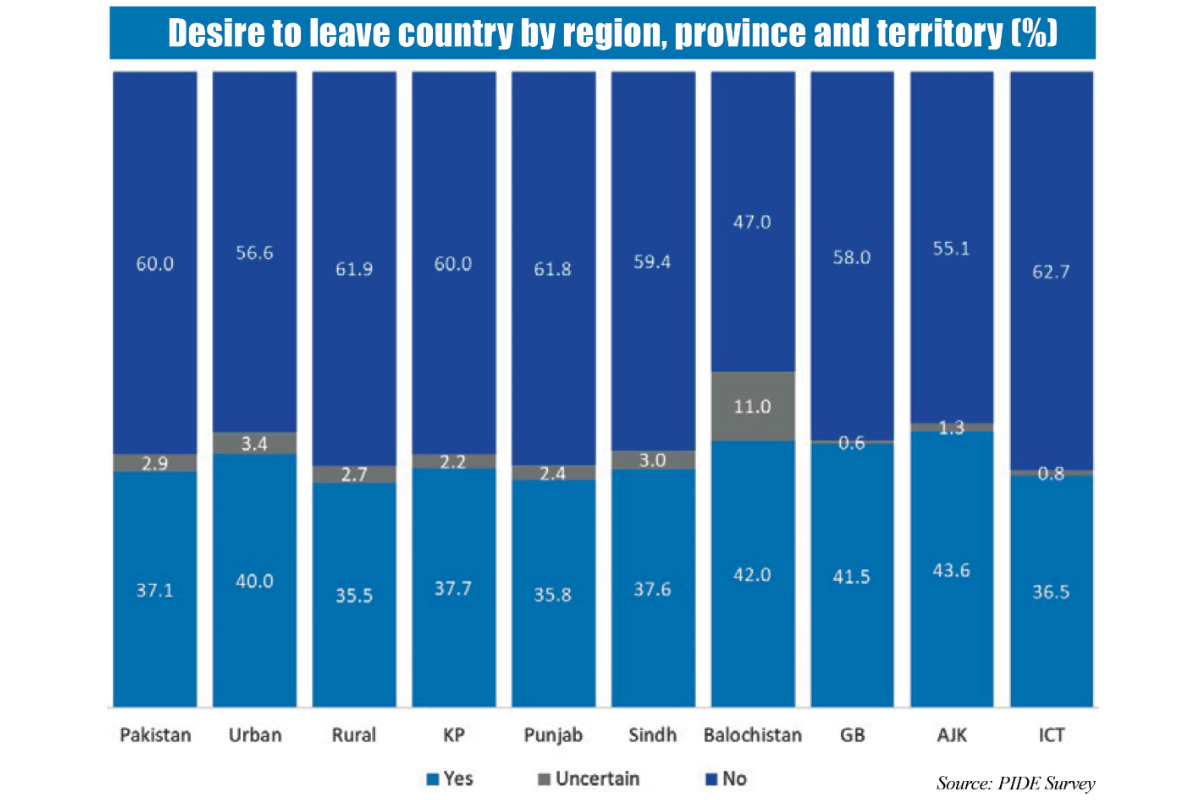
According to a survey by the Pakistan Institute of Development Economics (PIDE), about 37 per cent of Pakistanis would move abroad if given the chance. The survey reveals that 40 per cent of people living in urban areas have this desire, while 36 per cent of people in rural areas are captive to this desire.
Advertisement
In short, there is very little difference between the urban and rural populations of Pakistan concerning the desire to leave the homeland for good in search of better living conditions.
According to the report, among the four provinces, the highest desire to leave the country is among the residents of Balochistan, where 42 per cent of people want to leave Pakistan for good. It is followed by Khyber Pakhtunkhwa and Sindh. This desire is the lowest in Punjab – the most prosperous province of the country — but not that low because 35 per cent of Punjabis also want to leave the country.
According to PIED, among the three regions administered by Pakistan, the people of Kashmir are the most willing to leave the country, i.e. 44 per cent, followed by Gilgit-Baltistan. The freezing temperature in Pakistan’s mountainous areas including Gilgit-Baltistan and Azad Kashmir forces thousands to migrate to other cities including Islamabad, Rawalpindi and Karachi during winters. However, those who can afford to migrate prefer to settle down in the UK. Cities with large concentrations of Azad Kashmiris are Manchester, Bradford, Birmingham, Leeds and Luton. Today, there are an estimated 700,000 people from Azad Kashmir residing in the UK, 400,000 of whom are from the Mirpur region.
According to the survey report, Islamabad has the lowest proportion of people who want to leave the country among all administrative categories. Naturally so because being the capital of the country, the city is the world’s second most beautiful capital, designed uniquely and made eco-friendly. This city has a lot to offer, an eye-catching view, a peaceful environment, developed infrastructure, clean roads, and super cool people. Moreover, it’s inhabited by the country’s most privileged class – the bureaucrats and the politicians.
Balochistan has the lowest number of people wanting to stay in the country at 47 per cent, while 11 per cent of people in the province said they were undecided about whether they wanted to leave or stay. More than 60 per cent of people in Balochistan live below the poverty line. The province ranks lowest on health, education and other social indicators, not only in Pakistan but even in South Asia as a whole. Over 25 per cent of the population of Balochistan is between the ages of 15 and 29, and life is pretty much tough for them so these young men are left with no option but to leave the country for a better future.
Research has also shown that age and gender influence the way people perceive their identity. Men are more willing to leave the country than women. Similarly, a large number of 15 to 24-year-olds, 62 per cent, want to leave the country, but this desire decreases with age. Naturally so because as you grow old you just cannot afford to think of relocating yourself. Even, among the less educated, the desire to move out of the country is the least observed.
Advertisement
Why do people want to leave the country? According to PIDE, it is not easy to leave one’s home or one’s country, yet if people want to leave, there must be a very strong reason. The survey revealed that the main reason is economic difficulties.
According to the survey, the second major reason for the desire of Pakistanis to leave the country was to live with more dignity. According to the survey, the desire for more respect in Sindh and Balochistan is more than the desire for equal opportunities. Sindh showed the highest willingness to go abroad to feel better security, followed by Balochistan and Kashmir. Gender equality was most reported in Khyber Pakhtunkhwa as a reason for wanting to leave the country.
According to the data of the Pakistan Bureau of Immigration and Overseas Employment, from 1971 to June 2020, over 10 million Pakistanis went to 52 countries for employment.
Advertisement
Catch all the Urban Insight News, Breaking News Event and Latest News Updates on The BOL News
Download The BOL News App to get the Daily News Update & Live News.
End of Article






Advertisement

 Read the complete story text.
 Listen to audio of the story.